
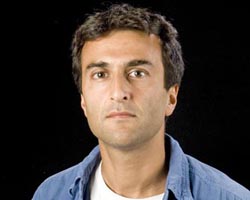
Professor of Materials Physics
APS Fellow
MA University of Cambridge
PhD University of Cambridge
Ferroic materials
We study ferroelectric and ferromagnetic materials using a range of fabrication and measurement techniques, e.g. to gain insight from detailed maps of surface magnetization, and detailed maps of thermodynamic parameters. The immediate focus is scientific, while the longer-term focus looks towards applications. Previous work on manganites and spintronics has given way to the current work described below, and many collaborators have been involved at all stages.
Electrocaloric effects
Electrocaloric effects are voltage-driven thermal changes that can be large and highly reversible near ferroelectric phase transitions. Electrocaloric materials have therefore been proposed for energy-efficient, environmentally friendly heat pumps, and with this ultimate goal in mind, we study materials, devices, and measurement protocols.
The field of electrocalorics was rejuvenated by our report of large electrocaloric effects in thin films [Science 311 (2006) 1270], and many years later we reported large electrocaloric effects in multilayer capacitors [Nature 575 (2019) 468]. Our first review article united electrocaloric materials and devices with their magnetocaloric and mechanocaloric counterparts [Nature Materials 13 (2014) 439]. Our second review article provided a critical update on the field of calorics [Science 370 (2020) 797].
Magnetoelectric effects
Magnetoelectric effects arise when magnetic and electrical quantities are interconverted by one or more materials, and the many possible applications include magnetic-field sensing and energy-efficient data storage. We use strain from voltage-driven ferroelectric substrates to modify magnetic domains and topology in films, patterned films and 2D materials. We then image the changes of magnetic and ferroelectric order using photoemission electron microscopy, and scanning probe microscopy.
Our review article summarized forgotten work from the past, and described the renaissance of the field in the new millennium [Nature 442 (2006) 759]. We subsequently reported large magnetoelectric effects at epitaxial planar interfaces [Nature Materials 6 (2007) 348], non-volatile electrically driven repeatable magnetization reversal with no applied magnetic field [Nature Communications 4 (2013) 1453], shear-strain mediated magnetoelectric effects that were revealed by imaging [Nature Materials 18 (2019) 840], and large magnetoelectric coupling in multiferroic oxide heterostructures that were assembled via epitaxial lift off [Nature Communications 11 (2020) 3190].
| Size and cost comparison for a one-cent multilayer capacitor that inadvertently functions as a room-temperature magnetic-field sensor that requires no electrical power [A one-cent room-temperature magnetoelectric sensor. C Israel, ND Mathur & JF Scott, Nature Materials 7, 93-94 (2008)]. | 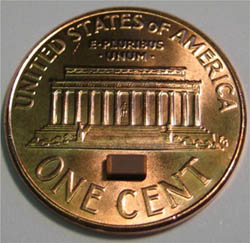 |
- X. Moya and N. D. Mathur, “Caloric materials for cooling and heating”, Science 370, 797 (2020) - DOI: 10.1126/science.abb097 - See Paper of the Month: "Calorics get the green light"
- D. Pesquera, E. Khestanova, M. Ghidini, S. Zhang, A. P. Rooney, F. Maccherozzi, P. Riego, S. Farokhipoor, J. Kim, X. Moya, M. E. Vickers, N. A. Stelmashenko, S. J. Haigh, S. S. Dhesi and N. D. Mathur, "Large magnetoelectric coupling in multiferroic oxide heterostructures assembled via epitaxial lift off", Nature Communications 11, 3190 (2020) - DOI: 10.1038/s41467-020-16942-x - See Paper of the Month: "We have lift-off"
- B. Nair, T. Usui, S. Crossley, S. Kurdi, G. G. Guzmán-Verri, X. Moya, S. Hirose and N. D. Mathur, "Large electrocaloric effects in oxide multilayer capacitors over a wide temperature range", Nature 575, 468 (2019) - DOI: 10.1038/s41586-019-1634-0 - See Paper of the Month: "Survival of the coolest"
- S. Crossley, B. Nair, R. W. Whatmore, X. Moya and N. D. Mathur, "Electrocaloric cooling cycles in lead scandium tantalate with true regeneration via field variation", PRX 9, 041002 (2019) - DOI: 10.1103/PhysRevX.9.041002 - See Paper of the Month: "Electrocaloric cycles bite back"
- M. Ghidini, R. Mansell, F. Maccherozzi, X. Moya, L. C. Phillips, W. Yan, D. Pesquera, C. H. W. Barnes, R. P. Cowburn, J.-M. Hu, S. S. Dhesi and N. D. Mathur, "Shear-strain mediated magnetoelectric effects revealed by imaging", Nature Materials 18, 840 (2019) - DOI: 10.1038/s41563-019-0374-8 - See Paper of the Month: "Shear is the new normal"
- E. Defay, G. Despesse, R. Faye, H. Strozyk, D. Sette, S. Crossley, X. Moya and N. D. Mathur, "Enhanced electrocaloric efficiency via energy recovery", Nature Communications 9, 1827 (2018) - DOI: 10.1038/s41467-018-04027-9 - See Paper of the Month: "Energy recycling"