![[logo]](index_files/logo6.jpg)
Inorganic Microstructures
This
research group currently comprises:
Dr Kevin
M. Knowles (Head of Group)
Majed Ali (Ph.D.
student)
Steve Lainé
(Ph.D. student)
Hassan Qarra
(Ph.D. student)
Professor John A. Fernie (Visiting Scientist)
Dr Anjan Sil (Visiting
Scientist from IIT Roorkee, India)
The research interests
of the group focus on the relationship between microstructure and the
mechanical and electronic properties of inorganic engineering materials.
Examples of research topics of interest are:
●
Deformation twinning in titanium
alloys
●
Devitrite, Na2Ca3Si6O16
● Elastic moduli of crystalline materials
● Hamaker constants of isotropic thin films between highly
anisotropic materials
● Joining of engineering ceramics for high temperature applications
● MAX phases in zirconium-based carbides
●
Microstructure of spherulites in
crystalline glazes
●
Molecular dynamics simulation of
twinning in devitrite and plagioclase feldspars
● Novel thin film zinc oxide varistors (UKIERI project with IIT
Roorkee)
●
Optically transparent hard
coatings
● Silicon nitride-silicon carbide particulate ceramics
● Silicon-pyrex bonding and aluminium-pyrex anodic bonding
● Sol-gel processing of lead-free NKN piezoelectric materials
Transmission electron microscope techniques are
routinely used by the research group, as well as scanning electron microscopy,
X-ray diffraction, mechanical testing and electrical characterisation.
Ph.D. projects for entry
in October 2017
Novel zinc oxide varistors
Varistors derive their non-linear current-voltage
characteristics from the addition of low levels of transition and heavy metal
oxides. It is usual for commercial compositions to have five or six oxide
additions. However, recent work here at
Anodic bonding is a common
process in microelectromechanical systems (MEMS). For
example, it is used to manufacture pressure sensors. Two materials, such as
silicon and pyrex, are
bonded together by applying a high
High temperature
brazing of engineering ceramics
The aim of this PhD project
is to examine by X-ray diffraction, scanning electron microscopy and
transmission electron microscopy, the microstructure of novel
particle-reinforced brazes for joining engineering ceramics such as alumina,
silicon carbide and silicon nitride to metallic materials such as nickel, so
that the joints can be used at service temperatures of > 500 ˚C.
Experience at
Microstructure of crystalline glazes
Crystalline glazes are
glazes in which large spherulites, visible by eye, are formed in a glaze during
the glazing process, such as in the example shown here.
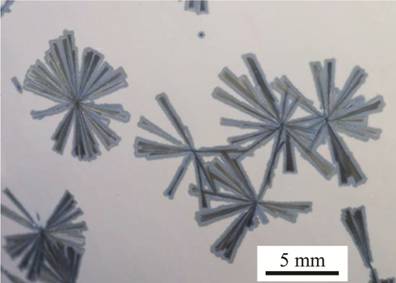
Typically these specialist
glazes are used by potters for aesthetic effects when making vases. The crystal
phase which grows in these glazes is usually willemite, Zn2SiO4,
arising from the incorporation of zinc oxide into silica-rich glazes. Traces of
other oxides such as cobalt oxide colour the willemite crystals. Other phases
can also be produced in crystalline glazes, usually unintentionally, but
arising as a consequence of the various glaze recipes used by different
practitioners of the art. It is only recently that modern microstructural
techniques of analysis have been applied to such glazes, e.g., K.M. Knowles and F.S.H.B. Freeman,
‘Microscopy and microanalysis of crystalline glazes’, Journal of Microscopy, 215, 257-270 (2004). This Ph.D. project will examine in depth further, more exotic,
examples of crystalline glazes, with the aim of establishing the nature of the
crystalline phases that are able to co-exist with willemite in crystalline
glazes and characterising in detail the nature of the willemite spherulites.
The experimental work will involve X-ray diffraction, transmission electron
microscopy, scanning electron microscopy and polarised light microscopy of
these fascinating glazes. A by-product of these spherulites is their ability to
diffuse light, reported recently in the paper K.M. Knowles, H. Butt, A. Batal,
A. Sabouri and C.J. Anthony, ‘Light scattering
and optical diffusion from willemite spherulites’, Optical Materials 52,
163-172 (2016).
Recent Research Group
Publications
1.
K.M.
Knowles, ‘The plane strain
Young’s modulus in cubic materials’, Journal of Elasticity, in
the press (2017).
2.
M.
Ali, K.M. Knowles, P.M.
Mallinson and J.A. Fernie,
‘Evolution of the interfacial phases in Al2O3–Kovar®
joints brazed using a Ag–Cu–Ti-based alloy’, Philosophical Magazine, in the press (2017).
3.
S.J.
Lainé, K.M. Knowles, P.J. Doorbar, R.D. Cutts and D. Rugg, ‘Microstructural characterisation of metallic shot
peened and laser shock peened Ti–Al–4V’, Acta Materialia 123, 350–361
(2017).
4.
H.
Butt, A.K. Yetisen, A.A. Khan, K.M. Knowles, M.M. Qasim, S.K. Yun and T.D.
Wilkinson, ‘Electrically tunable scattering
from devitrite-liquid crystal hybrid devices’, Advanced Optical Materials 5,
1600414-1–1600414-7 (2017).
5.
S.V.
Harb, S. H Pulcinelli, C.V. Santilli,
K.M. Knowles and P. Hammer, ‘A comparative study on graphene oxide and
carbon nanotube reinforcement of PMMA-siloxane-silica anticorrosive
coatings’, ACS Applied Materials
and Interfaces 8, 16339–16350 (2016).
6.
S.V.
Harb, F.C. dos Santos, S. H Pulcinelli, C.V. Santilli, K.M. Knowles and P. Hammer, ‘Protective
coatings based on PMMA-silica nanocomposites reinforced with carbon
nanotubes’, in Carbon Nanotubes
– Current Progress of their Polymer Composites, ed. Mohamed Reda Berber and Inas Hazzaa Hafez, Intech
publications, Chapter 7: pp. 195-225 (2016).
7.
K.M.
Knowles, ‘The biaxial moduli of cubic materials subjected to an
equi-biaxial strain’, Journal of
Elasticity 124, 1-25 (2016).
8.
K.M.
Knowles, H. Butt, A. Batal, A. Sabouri
and C.J. Anthony, ‘Light scattering and optical diffusion from willemite
spherulites’, Optical Materials
52, 163-172 (2016).
9.
M.
Ali, K.M. Knowles, P.M. Mallinson and J.A. Fernie, ‘Interfacial
reactions between sapphire and Ag–Cu–Ti-based active braze
alloys’, Acta Materialia 103, 859-869 (2016).
10.
M.
Ali, K.M. Knowles, P.M. Mallinson and J.A. Fernie, ‘Microstructural
evolution and characterisation of interfacial phases in Al2O3/Ag-Cu-Ti/Al2O3 braze joints’, Acta Materialia 96, 143-158 (2015).
11.
S.J.
Lainé and K.M. Knowles, ‘{1 1 -2 4} deformation twinning in commercial purity titanium at room
temperature’, Philosophical
Magazine 95, 2153-2166 (2015).
12.
K.M.
Knowles and P.R. Howie, ‘The directional dependence of elastic stiffness
and compliance shear coefficients and shear moduli in cubic materials’, Journal of Elasticity 120, 87-108 (2015).
13.
B. Kahr and K.M. Knowles, ‘Polarizing films’,
Chapter 26 of Tatsuo Kaiho (ed.) Iodine Chemistry and Applications, pp: 479-488, Wiley (2014).
14.
K.M.
Knowles and R.P. Thompson, ‘Growth of devitrite, Na2Ca3Si6O16,
in soda-lime-silica glass’, Journal of the American Ceramic Society 97, 1425-1433 (2014).
15.
A. Bhowmik , K.M. Knowles and H.J. Stone, ‘Discontinuous precipitation
of Co3V in a complex Co-based alloy’, Philosophical
Magazine 94, 752-763
(2014).
16.
H.
Butt, K.M. Knowles, Y. Montelongo, G.A.J. Amaratunga and T.D. Wilkinson, ‘Devitrite-based
optical diffusers’, ACS Nano 8, 2929-2935
(2014).
17.
B. Li
and K.M. Knowles, ‘Molecular dynamics simulation of albite twinning and
pericline twinning in low albite’, Modelling
and Simulation in Materials Science and Engineering 21, 055012 (18pp) (2013).
18.
B. Li
and K.M. Knowles, ‘Molecular dynamics simulation of twinning in
devitrite, Na2Ca3Si6O16’, Philosophical Magazine 93, 1582-1603
(2013).
19.
K.M.
Knowles and C.N.F. Ramsey, ‘Type II twinning in devitrite, Na2Ca3Si6O16’,
Philosophical Magazine Letters 92, 38-48
(2012).
20.
B. Mŏgulkoç, H.V. Jansen,
K.M. Knowles, H.J.M. ter Brake, and M.C. Elwenspoek ‘Surface devitrification and the growth of
cristobalite in Borofloat® (borosilicate 8330) glass’, Journal
of the American Ceramic Society, 93,
2713-2719 (2010).
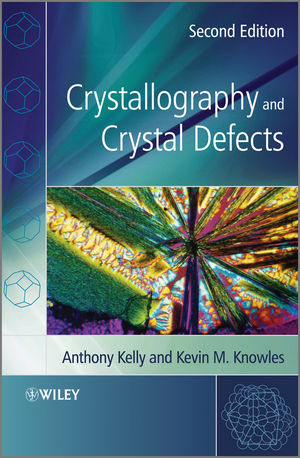
Crystallography and Crystal Defects (Second edition)
|
|
Published February 2012 ISBN 978-0-470-75014-8 (Paperback) Detailed worked solutions for all the
problem in this book are available on the Wiley web page accompanying it at
http://booksupport.wiley.com |
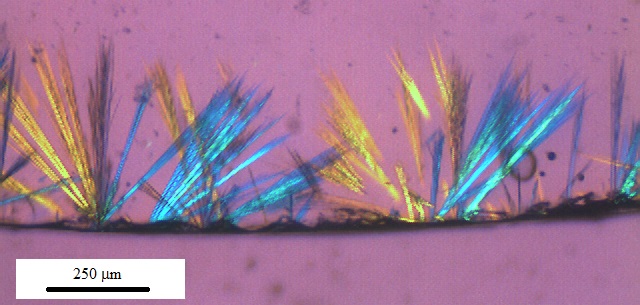
Needles of
devitrite crystals nucleated heterogeneously on the surface of soda-lime-silica
glass viewed by
transmitted light
polarised light microscopy with a sensitive tint at 45° to the polarizer
and analyser
(highlighted in the ACerS blog
Ceramic Tech Today in April 2014)
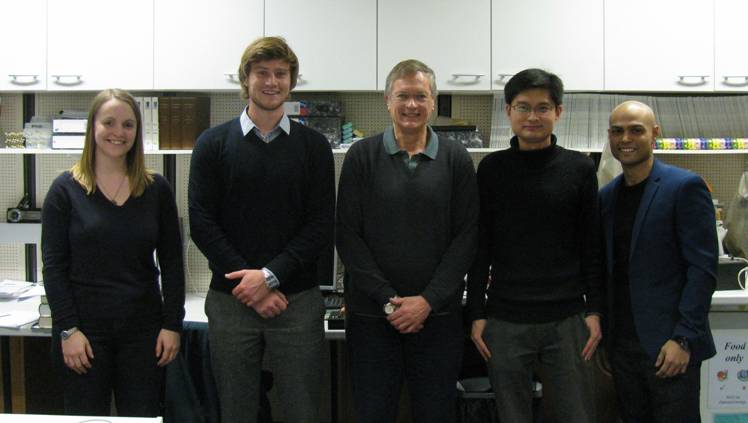
Research
Group, December 2012:
left to right:
Samantha O’Callaghan, Steve Lainé, Kevin Knowles, Bin Li, Majed
Ali
Former members of the
research group
Materials Science & Metallurgy Home Page
University of Cambridge Home
Page