Prof Colin Humphreys
 

Dr Ron Broom

Augustus Chee

Fang Fang

Mark Galtrey

David Holec

Jonathan Hollander

Carol Johnston

Clifford McAleese

Dr Rachel Oliver

David Rayment

Carmen Salcianu

Joy Sumner

Helen Xiu

Stanley Zhang

Diane Zhu

Dr. D. V. Sridhara Rao

Samantha Bennett

Thomas Sadler

Lewis Zhen-Yu Liu


Department of Materials Science and Metallurgy,
 New Museums Site,
 Pembroke Street,
 Cambridge,
CB2 3QZ,
United Kingdom.

Tel: 01223 334458
(Intl: +441223 334458)


Gallium nitride is probably the most important semiconductor material since silicon. It emits brilliant light as well as being the key material for next generation high frequency, high power transistors capable of operating at high temperatures.

The Cambridge Centre for Gallium Nitride is based in the Department of Materials Science and Metallurgy at the University of Cambridge. We are one of a small number of places in the world to have, in close proximity and on the same site, gallium nitride growth equipment, extensive advanced electron microscopy characterisation facilities, advanced x-ray diffraction characterisation facilities, atomic force microscopy, photoluminescence (PL) for measuring optical properties, Hall effect equipment for measuring electrical properties, and basic theory for understanding in detail physical properties. 

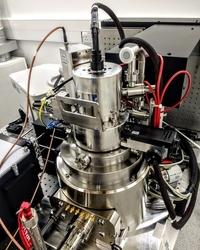
The heart of our GaN Centre is a new state-of-the-art Thomas Swan six two-inch wafer MOCVD growth system, which was established in collaboration with Thomas Swan Scientific Equipment Limited. The growth equipment is working extremely well and is producing world-class GaN-based materials and devices. Detailed structural characterisation is provided by a huge range of advanced electron microscopy and analysis equipment. For example we use HREM to measure layer widths to atomic precision, electron holography to measure internal electric fields across quantum wells, electron energy loss spectroscopy (EELS) to measure local concentrations of In in InGaN alloys (for example), advanced SEM to measure doping distributions, etc. We also have the latest advanced x-ray diffraction equipment to assess material quality, accurate In (say) concentrations, etc. 

Our research is at the cutting edge of GaN research world-wide and we have many exciting research projects under way. We have a strong collaboration with UMIST and University College London as well as with European Universities and a number of industries. Our research is financially supported by the Engineering and Physical Sciences Research Council (EPSRC), the European Union (IPAM Project), Thomas Swan and a range of other industries. 

The research team is undergoing significant growth as we move into exciting new GaN based research areas. We welcome new collaboration with universities and industries throughout the world, and we welcome new research students who want to apply to join our thriving research group. 

Professor Colin Humphreys CBE FRFng
Goldsmith's Professor of Materials Science
colin.humphreys@msm.cam.ac.uk
  Recent Publications
Determination of relative internal quantum efficiency in InGaN/GaN quantum wells'  (C.E. Martinez et al)    

J. Appl. Phys. 98, 053509 (2005)
 

Highlighting threading dislocations in MOVPE-grown GaN using an in situ
treatment with SiH4 and NH3(R.A. Oliver et al)

Journal of Crystal Growth Volume 289, Issue 2, Pages 506-514 (2006)  


Electron-beam-induced strain within InGaN quantum wells: false "cluster" detection in the TEM (T.M. Smeeton et al.) 
Applied Physics Letters, Vol. 83, p. 5419 (2003)
.


Media
An interview with Prof. Humphreys in Compound Semiconductor magazine. He discusses the recent history of the issue of indium clustering in quantum wells.
Full article (free registration required)

Prof Colin Humphreys’ interview on BBC Radio 4’s “Home Planet” programme (27th August 2002) discussing the use of LEDs in place of traditional bulbs for traffic lights. The green light in the modules are based on InGaN light emitters. Prof Humphreys’ contribution begins about 6 minutes and 50 seconds into the clip
Clip   More Info


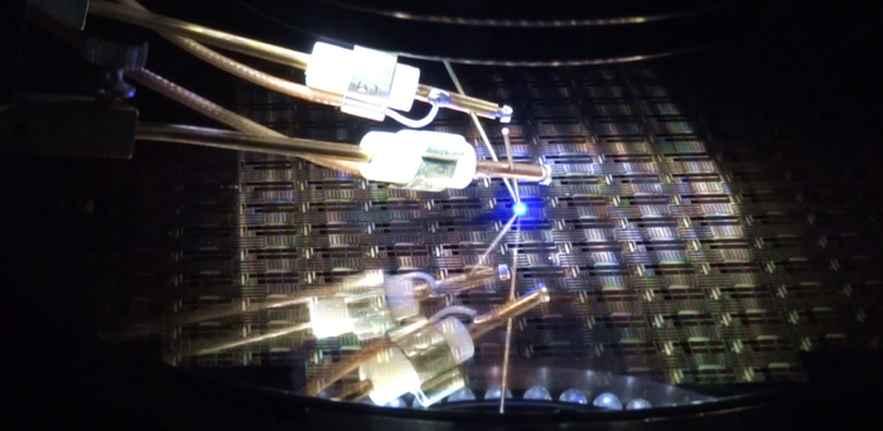
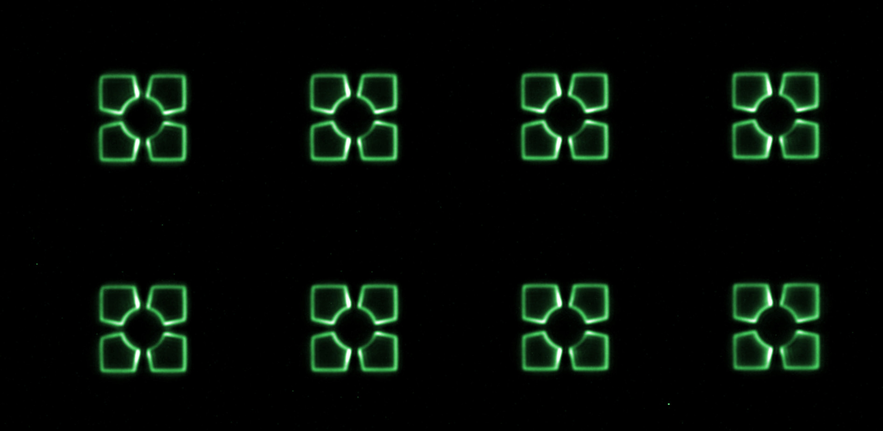
Images of packaged green LEDs based on InGaN multiple quantum well devices grown in our Thomas Swan MOCVD reactor.


Photos
Group punting trip on 25/08/05 to mark Margaret Beeston's retirement.


Please e-mail us with any comments on these pages.


(counting since 12-8-03)  


.